A brief overview of nursing management in pocket format. A recent event I attended further opened my eyes to that small caste, but really small in every sense, into which nursing management is transforming itself. It's true, I admit it very frankly, I have never particularly liked it and this feeling continues over time, enriched with new motivations and nuances, it is not fading. Years ago, in front of an illustrious representative of this management, who has now reached the peak of her career, I reserved for her the definition of "echo chamber" of medical management. Annoyed, she reeled off the list of all the things she could do in absolute autonomy, but did not specify within what freedom, interpreting my definition as what she herself called an "empty box." An echo chamber is indeed an empty box, but with a higher meaning, it cannot enjoy its own sound, but participates in the existence of an instrument in someone else's hands. It's not a matter of personal dislike, there is a rationale and what is it? It's easily explained. A term that is all in all quite simple in its meaning is self-referentiality, which stands for something that is based exclusively on itself and its own desires, without regard for relationships with other realities. The typical example proposed in this case is the sentence: "this sentence has five words," five words, indeed, express the meaning of its existence in a circular motion that breaks away from any kind of meaning external to it. The theory of self-referential systems is based on the general assumption that complex systems are not definable except with respect to their own components. Let's delve a little further into something that already begins to make one wrinkle their nose. The presentation of an event dedicated to management (once the "magnificent" were 7, now they have become 367), at a certain point states: "[...] there will be the possibility to socialize the state of negotiations and the opportunities that are emerging as well as the still critical issues, but also with the elements that we consider indispensable (?) for a management that is indisputably strategic for the whole system and on which any innovation that one wants to implement relies." You will have perceived how, through an articulation of subordinate clauses, the circle closes in a manner similar to the five-word sentence. A few days earlier, the FNOPI, organizer of this event, had crafted the slogan for International Nurses Day as follows: "healthcare does not work without nurses." In this sense, we all have the title of nurse (then it must be distinguished between those who simply have the title and those who actually practice the profession) even if in various curricula, the true nursing manager almost never mentions their basic training and on a specific date "is born" a manager. This implies that no clinical experience is absolutely necessary to manage those who have the clinic as their daily bread, who evidently make the NHS work but are fungible, therefore not deserving of particular attention regarding career and salary recognition, whereas management is strategic (στρατηγικός "that which is proper to the commander, the strategist"), so very simply it is stated that they are the ones who command, period. Those who become part of a complex system, self-justify themselves, building their own power system based on defined organizational charts and remain self-contained, something completely "other" compared to what they command. We are the simple system, the fungible ones, devoid of self-referentiality, because we simply don't need it, what we are worth we demonstrate daily and that's why we don't deserve any kind of recognition, unlike those of the complex system who, just because they draw on this peculiarity, define themselves as deserving to have elements recognized that they consider indispensable (if to renounce means "to voluntarily and clearly give up something that one already possessed with full right," declining it in the negative becomes: to voluntarily and decisively take possession of something that one does not possess with full right). Where the magnificent 367 want to go is now becoming sufficiently clear: they belong to a complex system, they are strategists of the nursing profession, even though they have never practiced it, they cannot renounce a right they intend to lucidly acquire, that is, to leave the sector and deserve separate bargaining like all other managers. And was it really necessary to make it so long to get to such a simple ending? In fact, I'm not good at taking shortcuts, I like to explain the reasons for things, I rely too much on common sense, on transparency in relationships, believing that recognition should be given based on what is clearly highlighted, you can't always pretend not to see and not to understand, while everyone is busy following their own path that voluntarily tends to exclude those who do not have the possibility to follow it, because they have simply made other choices, in any case allowing the functioning of everything that encompasses all systems. Thus the magnificent will become 367, what to say to the remaining 450,000, we continue to disperse our energies in a thousand streams, uselessly, with persistence and obstinacy, we rant on social media triggering and falling into polemical traps incapable of achieving any constructive purpose, meanwhile we already have those who eat their meal over our heads, happy with the show we are putting on. If we want to give a figurative conclusion to what I have tried to set out, we can imagine this climate in a way analogous to what surrounds us: everything we have produced as waste from our growth, microplastics that are entering every life cycle to return in turn to our bodies, pollution of all kinds, environmental devastation that finds no justification, have corrupted in the same way common sense, altruism, generosity, the desire to build together, because the future belongs to everyone, not to each as individual egocentrism. "And going into the dazzling sun; to feel with sad wonder how all life and its toil is in this following a wall; that has sharp shards of bottle on top." Eugenio Montale. Dario Porcaro
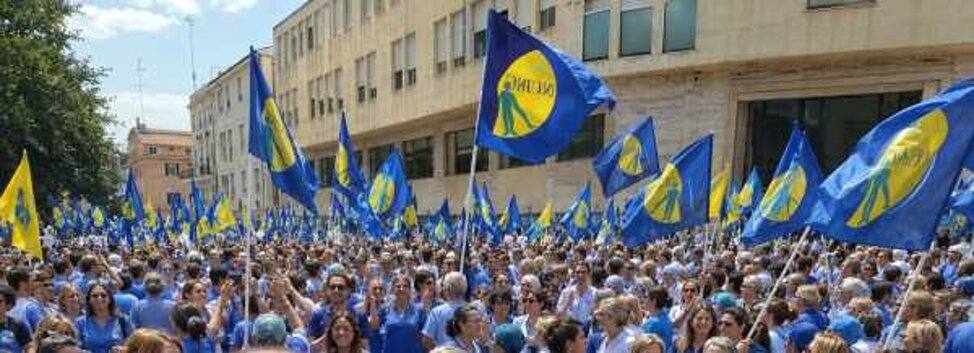
Lorem ipsum dolor sit amet, consectetur adipisicing elit, sed do eiusmod tempor incididunt ut labore et dolore magna aliqua.
TE LA DO IO LA DIRIGENZA!
TE LA DO IO LA DIRIGENZA!
2025-05-14 06:37
2025-05-14 06:37
Vincenzo
Vincenzo
INFERMIERI, il-potere-fa-male,

Chi entra a far parte di un sistema complesso, autogiustifica se stesso,

Suicidio medicalmente assistito: tutelare il paziente, ma anche chi lo assiste
Suicidio medicalmente assistito: tutelare il paziente, ma anche chi lo assiste L’Assemblea legislativa dell’Emilia-Romagna ha approvato la legge regio
2026-07-27 08:40:00
2026-07-27 08:40:00
Vincenzo
Vincenzo

Nuove Magistrali Infermieristiche: pronti alla partenza
Lauree magistrali specialistiche infermieristiche: un passo avanti, ma ora servono riconoscimento, carriera e retribuzione Prende forma il nuovo asset
2026-07-07 07:29:00
2026-07-07 07:29:00
Vincenzo
Vincenzo
.jpeg "Infermieri di famiglia e Comunità, proposta Nursing Up")
Infermieri di famiglia e Comunità, proposta Nursing Up
Infermieri di Famiglia e Comunità: è il momento del riconoscimento professionale. Mentre alcune sigle continuano a puntare tutto sulla figura dell'ass
2026-06-17 19:09:00
2026-06-17 19:09:00
Vincenzo
Vincenzo
Lorem ipsum dolor sit amet, consectetur adipisicing elit, sed do eiusmod tempor incididunt ut labore et dolore magna aliqua.