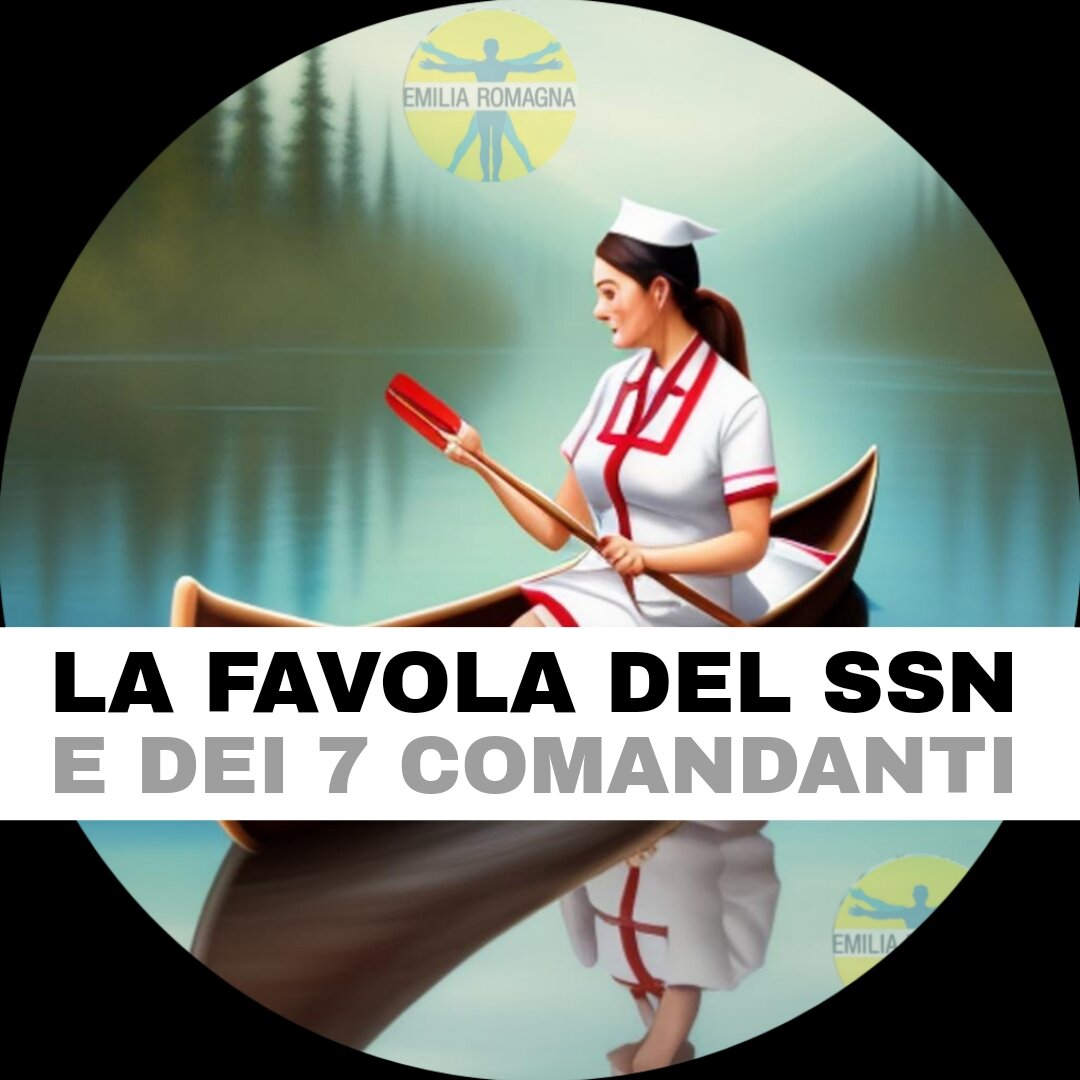


This fable recalls the events that happen daily in a national health system (NHS), the Italian one, which is increasingly in difficulty. An NHS that faces the challenge of offering quality services to citizens, but finds itself having to deal with problems of organization, management, bureaucracy, and waste. The NHS is represented by a canoe team, made up of only one rower and seven commanders, who have to compete against a Japanese team, made up of seven rowers and only one commander. The fable tells the adventures of the Italian team, which tries in vain to improve its performance by resorting to very expensive external consultants, structural changes, incentives for captains and supervisors, new canoes, but in the end is always defeated by the Japanese, who are more efficient and coordinated. The moral of the fable is that to achieve results you have to work as a team, reduce waste, value skills, and listen to professionals and the needs of citizens. The fable is inspired by a very well-known business parable: Two large canoe teams, one Italian and one Japanese, decide to challenge each other annually to see who is the best. The teams are very competitive and are made up of 8 men, both train hard to win the annual challenge. When the day of the race arrived, both teams were in shape, but the Japanese won with a one-kilometer lead. The Top Management of the Italian team could not explain how. So they decided to rely on a very expensive consulting firm to investigate and understand, so as to be prepared for the following year. After months of hard work, the agency understood the problem: they observed that the Japanese team had 1 captain and 7 rowers, while the Italian team had 7 captains and one rower. The conclusion was that there were too many commanders in the Italian team. The top managers, convinced that they would surely win the following year, decided to change the structure of the team courageously with the support of very expensive experts. The new formation of the canoe team consisted of 4 valiant commanders, 2 expert supervisors, a glorious chief supervisor, and a rower who had been given precise and additional instructions and responsibilities. The team trained hard and consistently, and finally the day of the rematch arrived. The Japanese took to the water with the same formation as always: one captain and seven rowers. To everyone's great surprise, especially Top Management, this time the Japanese did not win by one kilometer, but by a full 2 kilometers. The general manager was furious, while the Japanese one bowed to the rowers first and then to the captain. The Italian rower was immediately fired and labeled as incompetent and lazy. The next day, the general manager decided to still give a substantial productivity bonus to the commanders, supervisors, and chief supervisor for the great commitment and hard work done. The expensive consulting firm decided to call in other expensive experts and concluded that the tactic was correct and that they only needed to buy a new and very expensive canoe, which would allow the new rower to go faster. The Japanese are ready again for the new annual challenge, the Italians are currently busy designing the new canoe. Come to "infermieri fuori dal comparto" (Facebook group) and leave a comment or write to lapaginadinursingup@yahoo.it, we will publish your story, even anonymously.